
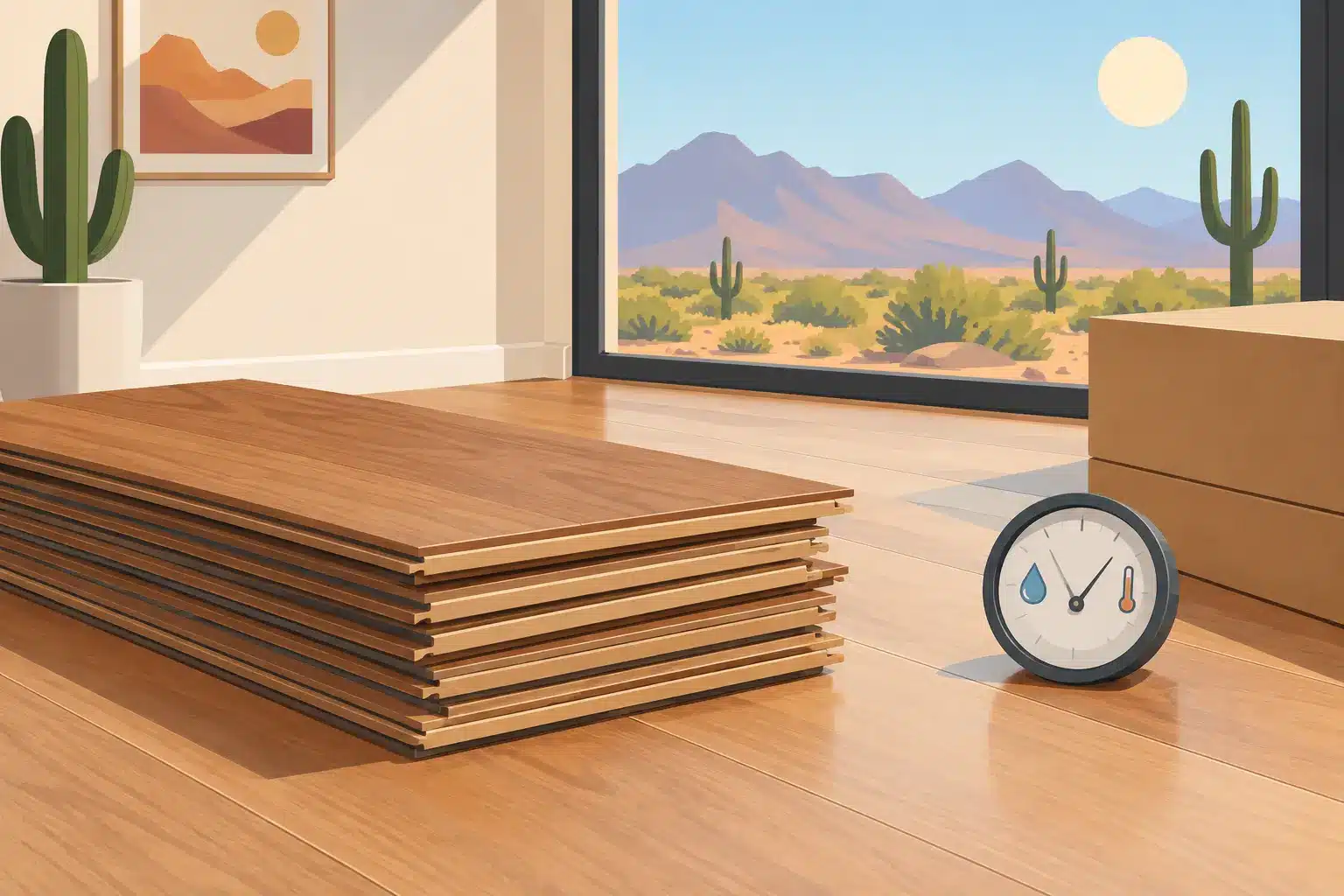
A new wood floor can look perfect on installation day and still develop gaps, cupping, or edge movement weeks later if it was brought into the home under the wrong conditions. This wood floor acclimation guide explains what Phoenix-area homeowners, remodelers, and property managers need to know before hardwood or engineered wood installation begins.
Wood is a natural material. It responds to changes in moisture in the air and in the subfloor by expanding or contracting. Arizona’s dry climate makes that especially relevant, but acclimation is not simply a matter of leaving boxes in a room for a certain number of days. The goal is to bring the flooring, subfloor, and indoor environment into conditions that match how the space will be lived in after installation.
What Wood Floor Acclimation Actually Means
Acclimation is the process of allowing wood flooring to reach an appropriate moisture content for the home where it will be installed. This happens only when the material is stored in a conditioned space with the home’s HVAC system running under normal occupancy settings.
The right amount of time varies. Wood species, board width, plank construction, packaging, subfloor material, indoor humidity, and the manufacturer’s instructions all affect the schedule. A flat rule such as “acclimate every floor for three days” can create problems because it ignores those variables.
For solid hardwood, moisture content is particularly critical because the board is wood throughout. Engineered hardwood is generally more dimensionally stable, thanks to its layered construction, but it still needs to be conditioned and tested according to the product specifications. Neither product should be assumed ready for installation just because it has arrived at the jobsite.
Why Phoenix Homes Need a Different Approach
Outdoor humidity in the Phoenix and East Valley area can be extremely low for much of the year. Yet the relevant condition is not the weather report. It is the indoor environment after the air conditioning, heating, windows, and daily living habits have done their work.
A home kept cool with air conditioning may have a much different relative humidity level than an unfinished house with open doors, wet drywall, or HVAC that has not been commissioned. A second home that sits unoccupied with the thermostat turned up can also experience different conditions than a primary residence.
The same applies to commercial spaces. An office, retail suite, or rental property should be acclimated based on its expected operating conditions, not temporary construction conditions. If a building is still cycling through major temperature and humidity swings, wood flooring should wait.
Prepare the Site Before Flooring Arrives
Acclimation cannot correct an unfinished or unstable jobsite. Wet trades and moisture-producing work should be complete before wood flooring is delivered. That includes drywall, texture, painting, plumbing work, masonry, and any work that introduces water into the building.
The building should be enclosed, with windows and exterior doors installed. Heating and air conditioning should be operating long enough to establish stable, normal indoor conditions. For a remodel, this also means checking for plumbing leaks, roof leaks, and moisture issues around exterior doors or slab edges.
Concrete slabs deserve particular attention in Arizona. A slab may feel dry to the touch while still holding moisture that can affect an adhesive or wood product. Professional installers use the test methods required by the flooring and adhesive manufacturers. Results determine whether the slab is suitable, whether a moisture-control system is needed, or whether the installation plan needs to change.
Wood subfloors need testing as well. The installer compares the subfloor moisture content with the flooring material and follows the manufacturer’s acceptable range. This is one of the reasons a professional site evaluation is worth scheduling before ordering material or locking in an installation date.
How to Acclimate Wood Flooring Correctly
Once the home is ready, the flooring should be delivered directly into the conditioned installation area or a nearby conditioned area with comparable conditions. Do not store wood flooring in a garage, on a covered patio, in a storage unit, or inside a home with the HVAC off. Those spaces can expose planks to conditions far different from the finished room.
Keep cartons off concrete and away from exterior walls or direct sunlight. Follow the flooring manufacturer’s instructions on whether boxes should remain sealed, be opened, or be racked with spacers between them. Different products have different packaging and acclimation requirements, so this detail matters.
A dependable acclimation process includes five practical steps:
- Set normal indoor conditions. Run the HVAC at the temperature and humidity levels the property will typically maintain after installation.
- Finish moisture-producing work first. Do not deliver flooring while drywall, paint, concrete work, or plumbing repairs are still adding moisture to the space.
- Store material in the right location. Keep cartons indoors in the conditioned area, protected from slab moisture and direct sun.
- Test instead of guessing. Check flooring and subfloor moisture content using appropriate meters and the product manufacturer’s requirements.
- Install only when conditions align. If the flooring, subfloor, or room conditions are outside the approved range, correct the cause before installation.
This approach may take longer than a calendar-based rule, but it reduces the risk of costly movement after the floor is installed.
Solid Hardwood vs. Engineered Wood
Solid hardwood offers the classic character many homeowners want and can often be refinished multiple times over its service life. Its trade-off is greater sensitivity to seasonal and indoor moisture changes. Wider solid planks, in particular, need careful moisture management and an installation plan suited to the site.
Engineered wood is built with a real hardwood wear layer over a stable core. It can be a strong choice for slab-on-grade homes common throughout the Valley, as long as the selected product is approved for the installation method and the moisture-control plan is correct. It is not a shortcut around site preparation. Engineered wood can still cup, gap, or fail if installed over an unsuitable subfloor or in a poorly controlled environment.
The best choice depends on the room, subfloor, desired plank width, household lifestyle, and budget. A main living area with a concrete slab may call for a different product than an upstairs room over a wood subfloor. Product selection and acclimation should be planned together, not treated as separate decisions.
Common Acclimation Mistakes to Avoid
The most common mistake is delivering flooring too early and storing it where conditions are uncontrolled. Another is installing while a home is still under construction because the project schedule is tight. Wood flooring is often one of the final finishes for a reason: it needs a stable environment.
Skipping moisture tests is another expensive gamble. A moisture meter reading can reveal a concern that is impossible to see with the naked eye. For glued-down installations, the adhesive manufacturer’s moisture limits and required testing methods are just as relevant as the flooring manufacturer’s guidance.
Homeowners should also avoid changing indoor conditions dramatically right after installation. Turning off the air conditioning for extended periods, leaving windows open during weather swings, or allowing a major plumbing leak to continue can affect any wood floor. Consistent climate control supports long-term performance and helps protect the manufacturer warranty.
When a Professional Evaluation Makes Sense
An experienced flooring professional can assess the installation area, explain how the selected material should be acclimated, identify moisture concerns, and confirm whether a slab or wood subfloor needs additional preparation. This is especially useful for wide-plank hardwood, glued-down engineered wood, older homes, rental properties, and commercial projects with firm opening dates.
At Premium Carpet Tile Stone and Wood, LLC, our team helps East Valley customers match wood products and installation methods to real site conditions, not just a showroom sample. A free in-home estimate provides a practical opportunity to review the subfloor, room use, and preparation steps before your flooring order is placed.
A wood floor should arrive in a home that is ready for it. Give the material stable conditions, follow the manufacturer’s testing requirements, and allow the installation schedule to support the floor you expect to enjoy for years.




Leave A Comment